5 Orders of Inheritance by Law in Ukraine in 2026: Who Inherits and in What Order
Who has the right to inherit if there is no will? We explain the 5 orders of inheritance by law, the right of representation, hereditary transmission and the deadline for accepting an inheritance.
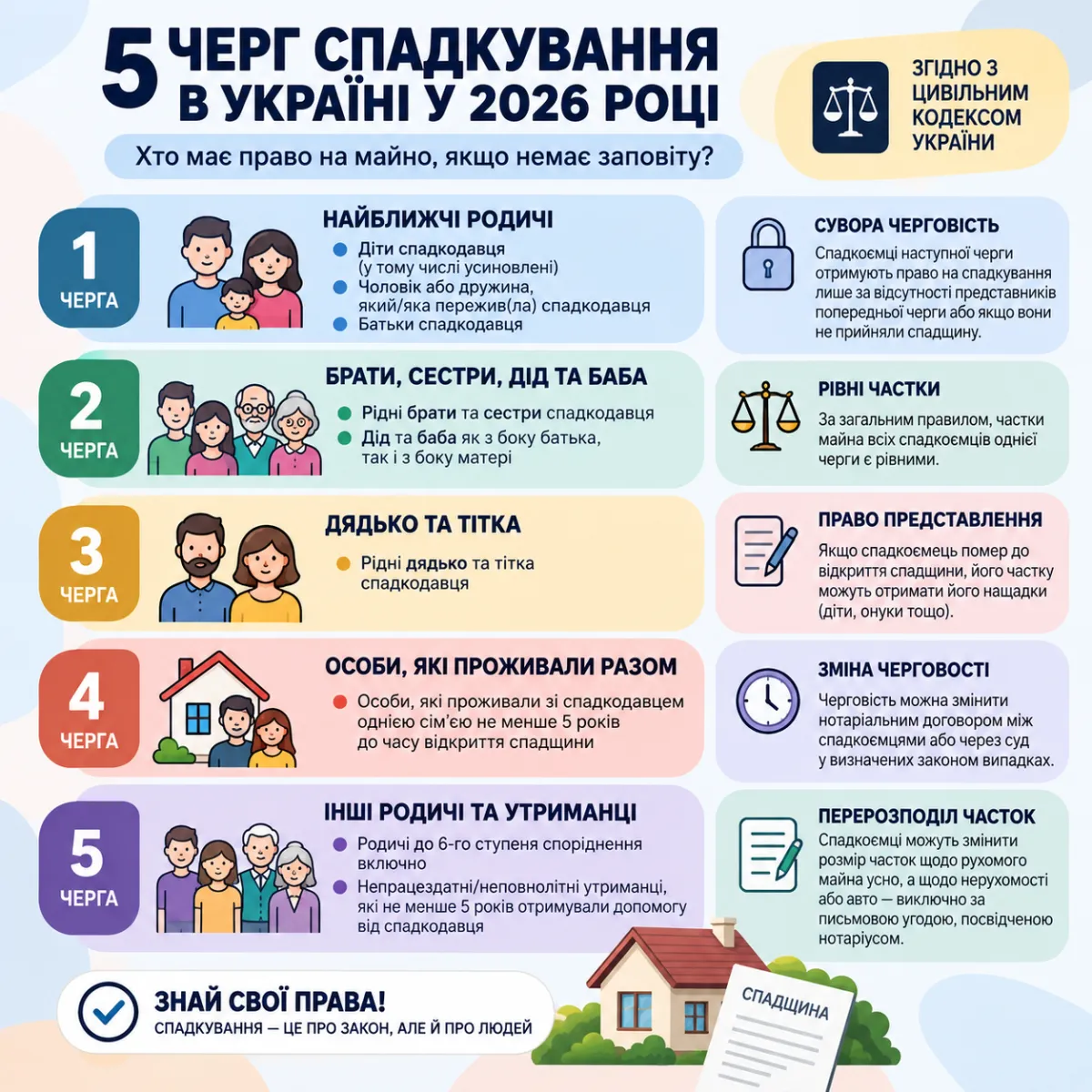
When a person dies without leaving a will, or the will does not cover the entire estate, an important question arises: who has the right to inherit, and in what order can relatives receive it?
In Ukraine, inheritance by law follows the order established by the Civil Code of Ukraine. The law provides for five orders of heirs by law. Each subsequent order, as a rule, obtains the right to inherit only in the absence of heirs of the previous order, if they are excluded from inheritance, do not accept the inheritance or renounce it.
Let us look at who belongs to each order, how the right of representation works, what hereditary transmission is, and what deadline is set for accepting an inheritance.
What Inheritance by Law Is
Inheritance is the transfer of the rights and obligations of a deceased individual — the testator — to the heirs.
In Ukraine, inheritance is carried out by will or by law.
If there is no will, it does not cover the entire estate, or other grounds provided by law apply, the rules of inheritance by law apply.
How the Order of Inheritance Works
Each subsequent order of heirs by law obtains the right to inherit if there are no heirs of the previous order, they are excluded from inheritance, do not accept the inheritance or renounce it.
Therefore, the mere existence of a relative in the fourth or fifth order does not mean that they will actually receive the estate.
1st Order: Children, Spouse and Parents
The first order includes:
• children of the testator;
• the spouse who survived the testator;
• parents of the testator.
This category also includes children conceived during the testator's lifetime and born after their death.
As a general rule, the shares of heirs by law are equal unless otherwise follows from the law or a duly executed agreement where such is permitted.
2nd Order: Brothers, Sisters, Grandmother and Grandfather
If there are no heirs of the first order, or they cannot inherit for reasons provided by law, the right passes to the second order.
It includes:
• full brothers and sisters of the testator;
• grandmother and grandfather on the mother's side;
• grandmother and grandfather on the father's side.
3rd Order: Full Uncle and Aunt
The third order of heirs by law includes:
• the testator's full uncle;
• the testator's full aunt.
At the same time, when determining heirs, the rules of inheritance by right of representation must be taken into account.
What the Right of Representation Is
The right of representation is a special inheritance mechanism under which certain relatives defined by law may inherit the share that would have belonged to their relative if that relative had been alive at the time the inheritance was opened.
For example, the testator's grandchildren and great-grandchildren may inherit the share that would have belonged to their mother, father, grandmother or grandfather under the relevant circumstances provided by law.
The right of representation is not a separate, sixth order of inheritance.
Right of Representation and Hereditary Transmission Are Not the Same
Hereditary transmission arises in a different situation: the heir was alive at the time the inheritance was opened but died after it was opened, without having accepted the inheritance.
In cases provided by law, the right to accept the share due to them passes to their heirs. The right to a compulsory share has separate regulation.
If the remaining period for accepting an inheritance by way of hereditary transmission is less than three months, it is extended to three months.
4th Order: Persons Who Lived with the Testator as One Family
The fourth order includes persons who lived with the testator as one family for at least five years before the time the inheritance was opened.
Importantly, a shared address of residence by itself does not always prove living as one family. A shared household, mutual rights and obligations, and other circumstances may matter.
Does a Common-Law Husband or Wife Inherit?
An unregistered partnership by itself does not equate a person to a husband or wife as a first-order heir.
However, a person who met the conditions established by law for living with the testator as one family may have the right to inherit in the fourth order.
5th Order: Other Relatives and Dependants
The fifth order includes:
• other relatives of the testator up to and including the sixth degree of kinship;
• dependants of the testator who were not members of their family, subject to the conditions established by law.
At the same time, relatives of a closer degree of kinship exclude relatives of a more distant degree from the right to inherit.
Who Is Considered a Dependant
For inheritance law, the mere fact of periodic financial assistance is not enough.
The criteria provided by law matter, in particular the person's status, the duration of maintenance, and whether the material assistance was the main or sole source of means of subsistence.
Therefore, belonging to this category is established taking into account the specific circumstances and documents.
Table: 5 Orders of Inheritance in Ukraine
• 1st order — children, the spouse who survived the testator, parents.
• 2nd order — full brothers and sisters, grandmother and grandfather on both sides.
• 3rd order — full uncle and aunt.
• 4th order — persons who lived with the testator as one family for at least 5 years.
• 5th order — other relatives up to and including the sixth degree of kinship and dependants defined by law.

Can the Order of Inheritance Be Changed
The law provides for cases where the order of obtaining the right to inherit may be changed.
Under the conditions established by law, this may happen by agreement of the heirs, and in certain situations — by a court decision.
In judicial resolution, long-term care by the testator, material support and other assistance to a person who was in a helpless state due to advanced age, serious illness or disability may matter.
What Is the Deadline for Accepting an Inheritance
The general deadline for accepting an inheritance is six months from the time the inheritance is opened.
At the same time, the procedure for acceptance depends on the circumstances of the specific heir. In particular, separate rules apply to a person who permanently lived with the testator at the time the inheritance was opened.
Therefore, the rule "did not file an application within six months — automatically lost the inheritance" should not be applied without analysing the specific situation.
What Happens If There Are No Heirs
If there are no heirs by will or by law, they are excluded from the right to inherit, did not accept the inheritance or renounced it, the law provides for a procedure to declare the inheritance escheat.
Such property does not automatically become ownerless. The procedure established by law applies to declare an inheritance escheat.
What Documents May Be Needed
The exact list of documents depends on the specific inheritance case.
For processing, the following may matter:
• identity documents;
• documents confirming the testator's death;
• documents confirming family ties;
• documents concerning the inherited property;
• information about the place of residence;
• other documents depending on the circumstances of the case.
If family relations cannot be confirmed by documents, or there are discrepancies in the documents, additional legal steps may be required.
Key Points About the 5 Orders of Inheritance
The first order — children, husband or wife and parents.
The second order — full brothers and sisters, grandmother and grandfather.
The third order — full uncle and aunt.
The fourth order — persons who lived with the testator as one family for at least five years.
The fifth order — other relatives up to and including the sixth degree of kinship and dependants provided by law.
When processing an inheritance, the right of representation, hereditary transmission, deadlines for accepting the inheritance and the possibility of changing the order must also be taken into account.
If you need to determine your order of inheritance, open an inheritance case or process an inheritance in Kyiv, contact a notary to analyse your specific situation.
For a consultation and inheritance processing in Kyiv, contact the Notkontora 131 notary office. Explore also: opening an inheritance case, certificate of the right to inherit by law and power of attorney for inheritance processing.
Frequently asked questions
How many orders of inheritance are there in Ukraine?
The law establishes five orders of heirs by law.
Who belongs to the first order of heirs?
The testator's children, the spouse who survived them, and the parents.
Who inherits if there are no first-order heirs?
As a general rule, the right passes to the second order — the testator's full brothers and sisters, and their grandmother and grandfather on the mother's and father's side.
Can a common-law wife or husband receive an inheritance?
Under the conditions established by law, a person who lived with the testator as one family for at least five years before the inheritance was opened may belong to the fourth order. An unregistered partnership by itself does not make a person a first-order heir.
What is the right of representation?
It is a mechanism provided by law under which certain relatives inherit the share that would have belonged to the respective relative if that relative had been alive at the time the inheritance was opened.
What is the deadline for accepting an inheritance?
The general deadline is six months from the time the inheritance is opened, but the procedure for acceptance depends on the specific circumstances.
Kyiv notary: practical conclusions on the topic of the article
The material is based on applied practice. If your case differs from the standard one, a Kyiv notary will help you adapt the procedure to specific circumstances.
In most procedures, correct details, compliance with deadlines and the correct sequence of steps are decisive.