Legal Concepts Explained Simply: Inheritance, Will, Gift, and Notarial Documents
How do renunciation and non-acceptance of inheritance differ? Gift or will? Certification of a transaction vs. signature authentication? Copy vs. duplicate. A notary explains in 2026.

Legal Concepts That Are Often Confused
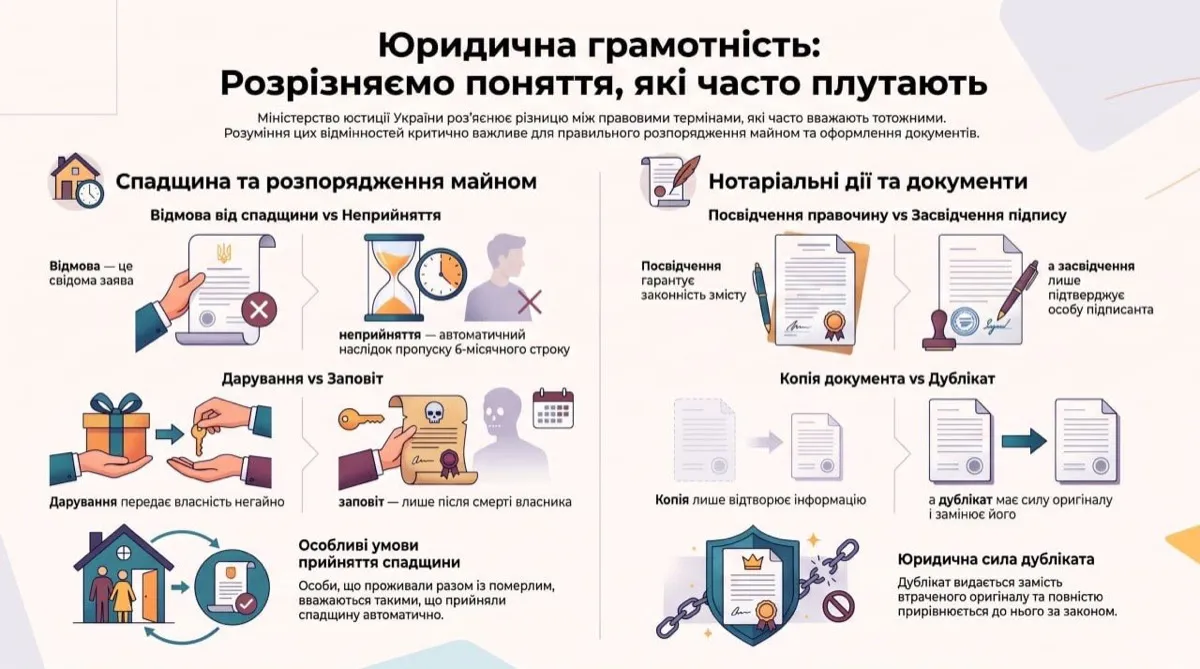
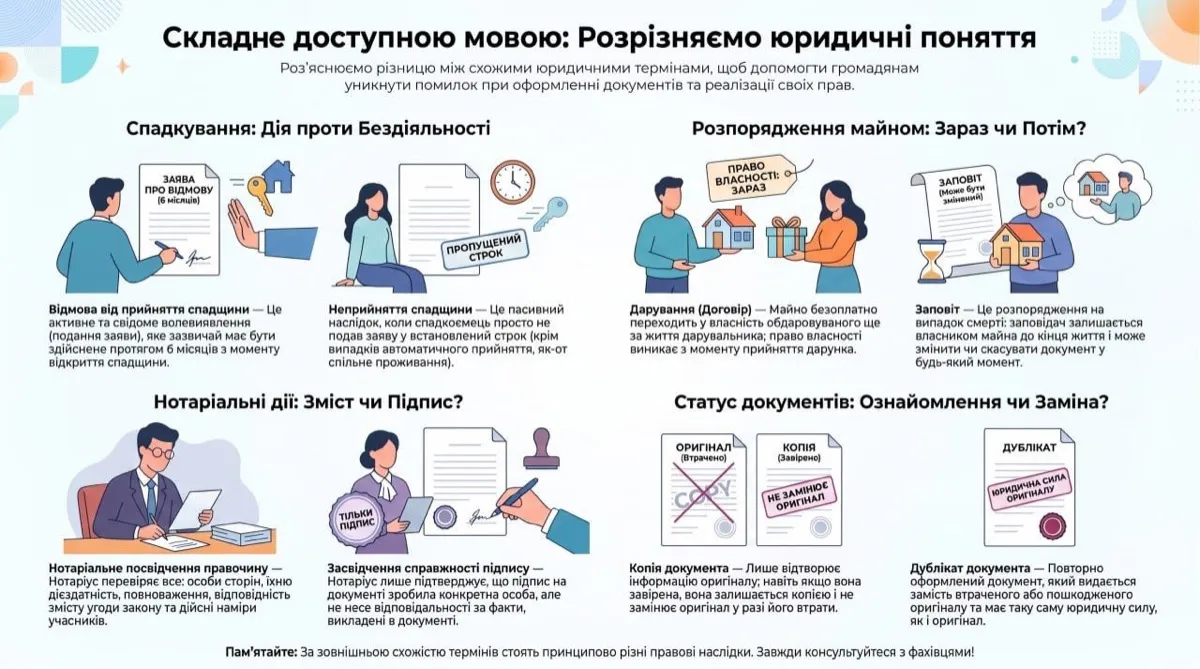
In notarial practice, even legal concepts that look similar at first glance can have completely different legal consequences. Renunciation and non-acceptance of inheritance, gift and will, notarial certification of a transaction and signature authentication, a copy of a document and its duplicate — these are not synonyms.
Misunderstanding the difference between them can lead to missed deadlines, the loss of the opportunity to formalize inheritance rights, incorrect disposal of real estate, or the use of a document that lacks the necessary legal force.
Below we break down the key concepts in accordance with Ukrainian legislation, current as of September 9, 2026.
Renunciation and Non-Acceptance of Inheritance: What is the Difference?
These concepts are often used interchangeably, although from a legal point of view they have a different nature.
Renunciation of Inheritance
Renunciation is a deliberate expression of the heir's will aimed at not accepting the inheritance.
An heir by will or by law has the right to renounce the inheritance within the period established for its acceptance. Such a renunciation is unconditional and unreserved.
It is also important to remember that the law links the procedure for accepting an inheritance to whether the heir permanently resided with the testator at the time the inheritance was opened.
Non-Acceptance of Inheritance
Non-acceptance of an inheritance may arise not as a result of an active renunciation, but because the heir did not perform the necessary actions within the period established by law.
The general period for accepting an inheritance is six months.
However, there is an important exception: if the heir permanently resided with the testator at the time the inheritance was opened, they are considered to have accepted the inheritance unless they declared a renunciation within the established period.
By contrast, an heir who wishes to accept the inheritance but did not permanently reside with the testator must submit an application for acceptance of the inheritance in the manner prescribed by law.
Therefore, the statement "did not submit an application within 6 months — automatically lost the inheritance" cannot be applied equally to all heirs. The circumstances of each specific inheritance case must be established.
Can You Renounce Only Part of an Inheritance?
Acceptance of an inheritance cannot be made with a condition or reservation. An heir cannot arbitrarily divide a single inheritance according to the principle: I accept the apartment, but not the unfavorable obligations.
That is why, before accepting a significant inheritance, it is advisable to establish not only the composition of the testator's assets but also the existence of obligations that, under the law, may be part of the inheritance.
Gift and Will: Now or After Death?
These are two more concepts that are often compared when the owner of an apartment, house, or other property wants to transfer it to a loved one. But the legal consequences of a gift and a will are fundamentally different.
What Happens with a Gift?
Under a gift agreement, one party transfers or undertakes to transfer property into the ownership of the other party free of charge, either immediately or in the future.
When it comes to an apartment, house, or other real estate, a gift is a way of transferring ownership during the donor's lifetime, not after their death.
After the agreement is properly executed and the transfer of ownership is state-registered, the former owner can no longer treat the gifted apartment as if it still belonged to them.
What is a Will?
A will, by contrast, is the personal disposition of an individual for the event of their death.
Before the inheritance is opened, a will by itself does not transfer ownership of the apartment to the heir. The testator remains its owner and may dispose of their property during their lifetime. Moreover, a will can be amended or revoked in the manner prescribed by law.
The difference can be simplified as follows: a gift is a transfer of property during one's lifetime; a will is a disposition of property for the event of death.
But the choice between them should not be made on this criterion alone. It is necessary to consider the family situation, the composition of the property, the rights of other persons, and the desired moment of transfer of ownership.
Mandatory Share in Inheritance: Does a Will Always Decide Everything?
No. Freedom of testamentary disposition in Ukraine has legislative limits.
Regardless of the content of the will, the following may have the right to a mandatory share:
• minor children of the testator;
• underage children;
• adult children who are unable to work;
• a widow or widower who is unable to work;
• parents who are unable to work.
As a general rule, they inherit half of the share that would have been due to each of them in the case of inheritance by law.
This is an important clarification: "half of the mandatory share" does not automatically mean 50% of the apartment or 50% of the entire inheritance.
For example, if under inheritance by law a specific heir would have received 1/4 of the inheritance, their mandatory share as a general rule would be half of that 1/4.
Notarial Certification of a Transaction and Signature Authentication: Different Notarial Acts
Another common mistake is to assume that the phrases "to notarially certify a document" and "to notarially authenticate a signature" mean the same thing. They do not.
What Does Notarial Certification of a Transaction Mean?
When certifying a transaction, the notarial act concerns the transaction itself and compliance with the legally established requirements for its execution.
Depending on the type of transaction, the notary establishes the identities of the participants, verifies their civil capacity, the authority of representatives, the necessary documents, and other legally significant circumstances.
For example, when disposing of property held in joint co-ownership, the law establishes special rules on the participation of co-owners or the receipt of the relevant consent.
And What Does Signature Authentication Mean?
Here the scope of the notarial act is different. When authenticating a signature, the notary does not certify the facts set out in the document but confirms that the signature was made by a particular person.
In addition, the notary authenticates signatures on documents, except for those which, under the law or at the request of the parties, must be notarially certified.
Therefore, notarial signature authentication does not automatically turn any document into a notarially certified transaction. These are fundamentally different legal procedures.
Copy and Duplicate of a Document: Why They Are Not the Same
In everyday life, the word "duplicate" is sometimes used as a synonym for the word "copy". In the legal sense, this is incorrect.
What is a Certified Copy?
A copy reproduces the information of the original document. When notarially certifying the accuracy of a copy, the notary personally compares the copy or extract with the original document.
But a certified copy does not, by itself, become a new original of the document. Its purpose is to confirm the correspondence of the reproduced information to the presented original within the scope of the relevant notarial act.
What is a Duplicate?
A duplicate has a different legal status. In the event of loss or damage to a document certified or issued by a notary, a duplicate may be issued upon a written application by the persons provided for by law.
A duplicate must contain the full text of the certified or issued document. It bears a special note that it has the force of an original, and a certification inscription is made. The original document is then considered to have lost its force.
The difference can be remembered this way: a copy confirms the correspondence of the information to the original; a duplicate, in cases provided for by law, is issued instead of a lost or damaged document and has the force of an original.
When Can a Duplicate of a Notarial Document Be Obtained?
Under the current rules, a duplicate may be issued in the event of loss or damage to a document that was certified or issued by a notary.
In particular, the persons on whose behalf or in respect of whom the relevant notarial act was performed may apply. The rules also provide for the possibility of issuing duplicates in certain cases to the legal successors or heirs of such persons, to the executor of the will, and at the request of the notary who opened the inheritance case.
Therefore, if, for example, a notarially certified document has been lost, one should not immediately assume that the legal situation cannot be restored.
What Changed in Notarial Procedures in 2026?
In 2026, the Ministry of Justice introduced amendments to the Procedure for the Performance of Notarial Acts by Notaries of Ukraine. The changes concerned, in particular, certain procedural issues of the notary's work with representatives, the execution of consents, and other notarial acts.
Therefore, when preparing a specific contract, application, inheritance case, or other notarial act, it is advisable to rely not on old document templates from the internet, but on the requirements in force at the time of application.
Why Is It Important to Correctly Distinguish Legal Concepts?
The difference between similar legal terms is not a formality. Correct understanding may determine: whether the apartment will pass into ownership now or only after the owner's death; whether the inheritance is considered accepted; whether an application must be submitted to a notary; whether a person has the right to a mandatory share; what exactly the notary certified — a transaction or only the authenticity of a signature; whether a document may be used in place of a lost original.
Special care should be taken in matters of inheritance, real estate, gifts, wills, and notarial document processing.
If you are unsure which notarial act is required in your situation, it is advisable to consult a notary before signing documents or before the legally established deadlines expire.
For consultation and notarial acts in Kyiv, you can contact our notary office. Explore also: opening an inheritance case, last will and testament and apartment gift agreement.
Kyiv notary: practical conclusions on the topic of the article
The material is based on applied practice. If your case differs from the standard one, a Kyiv notary will help you adapt the procedure to specific circumstances.
In most procedures, correct details, compliance with deadlines and the correct sequence of steps are decisive.