Lifetime Maintenance Contract in Ukraine 2026: Terms, Cost, Termination and Risks
What a lifetime maintenance (care) contract is, which terms are mandatory under the Civil Code, what a notary charges for it, when a court terminates such a contract and how the transferred property is returned.

A lifetime maintenance (care) contract is an arrangement under which a person transfers ownership of an apartment, a house or other property to another party and receives lifelong financial support and care in return. For an elderly person who is left without support, it often solves three problems at once: the right to keep living in the same home, a monthly income, and certainty that the property will go to a particular person rather than be divided among statutory heirs.
Below is a structured review of the arrangement under the Civil Code of Ukraine: the mandatory terms, the restrictions imposed on the new owner, the fees charged by a notary, the tax consequences, and how the Supreme Court approaches termination of such contracts.
In short: what the contract is
Article 744 of the Civil Code of Ukraine defines it directly: one party (the transferor) transfers ownership of a residential house, an apartment or a share in them, other immovable property, or movable property of significant value to the other party (the acquirer), and the acquirer undertakes to provide the transferor with maintenance and (or) care for life.
Under a lifetime maintenance (care) contract, one party (the transferor) transfers ownership of a residential house, an apartment or a share in them, other immovable property, or movable property of significant value to the other party (the acquirer), in exchange for which the acquirer undertakes to provide the transferor with maintenance and (or) care for life.
Civil Code of Ukraine, Article 744
The decisive word is “for life”. The contract has no term after which the obligations simply end: it runs until the transferor dies. This is why preparation takes longer than in a sale and purchase — ownership passes immediately, while the duty of care has only just begun.
The property is described precisely: address, floor area, and the objects included. There is no universal template, so the deed is certified by a notary with an individually drafted text — a lifetime maintenance contract is prepared with a description of the apartment, the monthly amount and the list of the acquirer’s duties.
When this arrangement is the right choice
- an elderly person living alone transfers an apartment to a relative or a trusted person and receives money and care instead of being left without help;
- spouses transfer their joint apartment to one of the children — the acquirer’s obligations are reduced proportionally if one of the co-owners dies (Article 747, part 1 of the Civil Code);
- the transferor does not want the property to pass to statutory heirs and prefers to give it to the person who actually provides care;
- a person without heirs transfers a house or a land plot in exchange for maintenance and a funeral — burial is a duty of the acquirer under Article 749, part 3 of the Civil Code, even if the contract does not mention it.
The arrangement fits less well when the goal is a quick transfer of property without a long-term obligation. A lifetime maintenance contract cannot be “covered” by an oral understanding that no care will actually be provided: the acquirer’s duties remain legally binding, and their non-performance gives the transferor a right to go to court.
Who may be a party
Article 746 of the Civil Code is broad as to the transferor, but imposes one strict requirement on the acquirer:
- the transferor may be a natural person of any age and state of health; the transaction must meet the general validity requirements of Article 203, meaning the person must understand their actions;
- the acquirer may be an adult capable natural person or a legal entity; a minor or an incapacitated person cannot act as acquirer;
- where there are several acquirers, they become co-owners of the property under joint ownership, and their duty towards the transferor is joint and several;
- the contract may be concluded by the transferor in favour of a third party — where the maintenance and care are provided to a person designated by the transferor.
Terms that should always be written into the contract
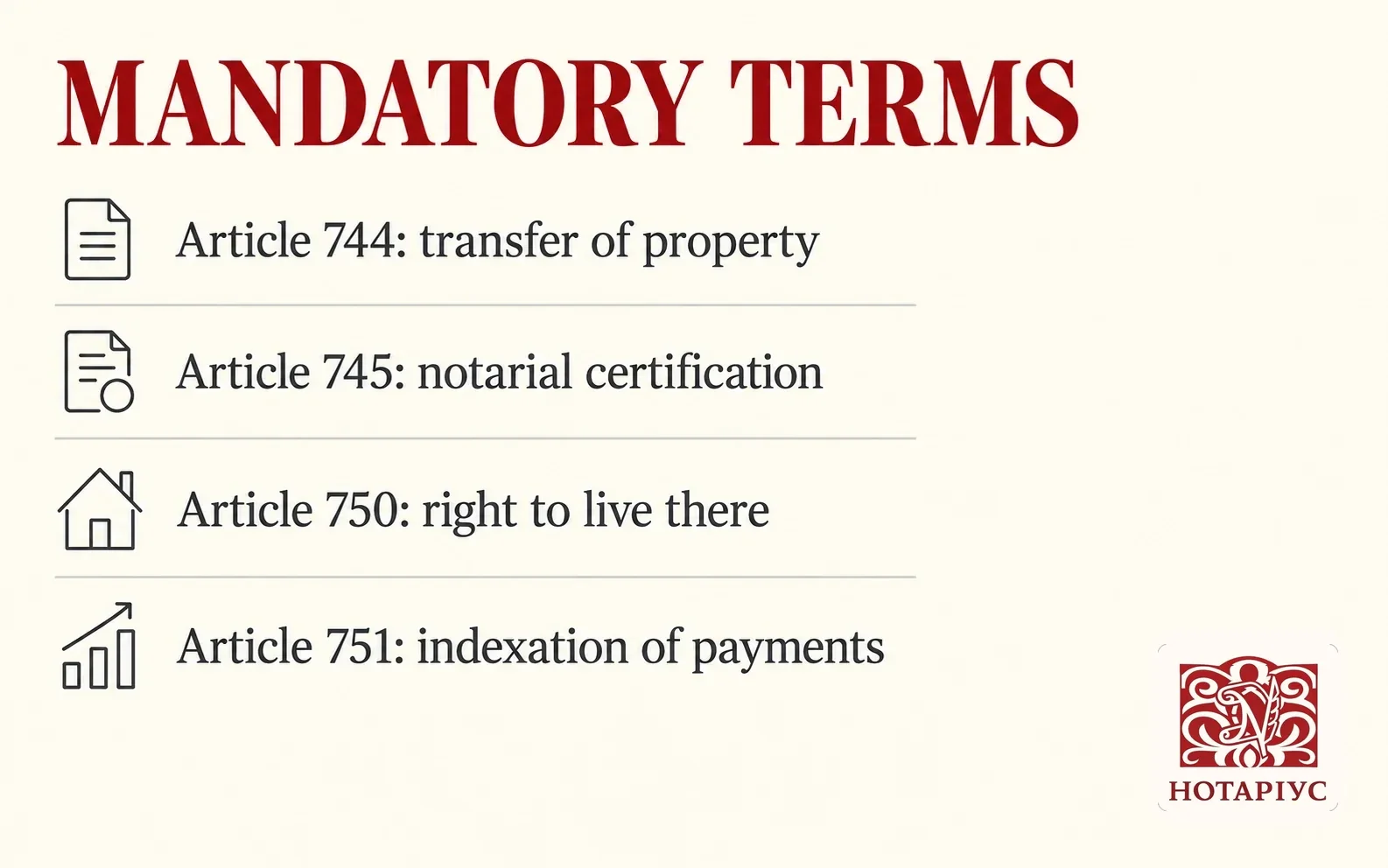
The law does not provide an exhaustive checklist, but Articles 749–751 of the Civil Code define the content of the obligation. The more specific the wording, the fewer grounds for a dispute years later:
- types of financial support: a monthly sum, payment of utility bills, medicines, groceries, home repairs;
- types of care: care during illness, accompanying the person to a doctor, help with household tasks, cleaning, cooking;
- housing: exactly which part of the premises the transferor is entitled to live in — Article 750 requires this part to be defined specifically;
- the monetary value of the monthly support, which is subject to indexation in the manner established by law (Article 751 of the Civil Code);
- how performance is documented: receipts, bank transfers with a clear payment purpose, records of care actually provided;
- reimbursement of funeral expenses and the settlement procedure if part of the property passes to the transferor’s heirs.
Where particular duties are not specified, a dispute is resolved “in accordance with the principles of fairness and reasonableness” (Article 749, part 2 of the Civil Code). The rule is lawful but works against both parties: the scope and amount of care are decided by a court at its discretion.
Housing for the transferor: what must be specified
The most sensitive point is where the person will live after signing. Article 750 of the Civil Code allows the acquirer to be obliged to provide housing for the transferor or a third party in the transferred house or apartment. In that case the contract must specifically define the part of the premises in which the transferor is entitled to live.
A practical minimum: the room or rooms, their size, the floor, heating and lighting arrangements, and the right to use the kitchen, bathroom and common areas. Worsening these conditions is a breach of contract, not a domestic detail.
Form of the contract, notarial certification and the ban on disposal
Article 745 of the Civil Code is concise: a lifetime maintenance contract is concluded in writing and is subject to notarial certification. Failure to comply with the form makes the transaction void — an oral agreement about “looking after the apartment” has no legal effect.
The notary separately imposes a ban on the disposal of the transferred property and records it on every copy of the contract (Article 73 of the Law of Ukraine “On the Notariat”). This is not a formality but a direct protection mechanism for the transferor.
The notary verifies the value of the property against the documents: the calculation of fees requires a valuation rather than a price from an advertisement. If the parties have not settled the value of an asset, certification is postponed until a valuation is obtained.
When the acquirer becomes the owner
Under Article 748 of the Civil Code the acquirer becomes the owner of the transferred property in accordance with Article 334. For a transaction subject to notarial certification, ownership arises from the moment of that certification. There is no need to wait for the transferor’s death to obtain title: the acquirer becomes the owner immediately.
This is what distinguishes the arrangement from a will: a will only appoints an heir for the future and can be changed at any time, whereas here ownership has already passed.
Restrictions on the acquirer: disposal and enforcement
Article 754 of the Civil Code strictly limits the new owner until the transferor dies:
- the acquirer may not sell, give away or exchange the transferred property, conclude a pledge over it, or transfer it to another person under any other transaction;
- no enforcement may be levied on that property during the transferor’s lifetime — even the acquirer’s creditors cannot take it;
- loss (destruction) or damage to the property does not terminate or reduce the acquirer’s obligations.
Lifetime maintenance or an inheritance contract
The two transactions are almost always confused, because both involve transferring property and assuming duties towards another person. The difference lies in the moment ownership passes and in the transferor’s freedom:
- under a lifetime maintenance contract the property passes into ownership immediately upon certification, and the acquirer takes on lifelong support;
- under an inheritance contract the property defined in it passes to the acquirer after the transferor’s death, and the transferor may not dispose of that property or leave it to other persons by will.
The practical rule: if a person should receive the property and support under it at once, a lifetime maintenance contract is used. If the property should pass only after death and the transferor wants to keep more options open, an inheritance contract is concluded instead. The two are not interchangeable: the choice made once can be changed not by signing the other version but by a new contract or a court decision.
Compared with a will and a deed of gift
| Point of comparison | Lifetime maintenance | Will | Deed of gift |
|---|---|---|---|
| When ownership passes | immediately upon certification | after the testator’s death | immediately upon certification |
| What the transferring party receives | maintenance and care for life | nothing during their lifetime | nothing; the gift is unconditional |
| Can the property be disposed of later | no, until the transferor dies | no, ownership has not passed yet | yes, without returning the property |
| Can the decision be changed | termination only through a court | a will can be amended or revoked | revocation is limited by law |
| Protection from enforcement | yes, during the transferor’s lifetime | the heir does not own the property yet | the property belongs to the donee |
Choosing between a gift and lifetime maintenance is not a matter of taste. Under a deed of gift of an apartment the person loses the property at once and receives no counter-obligation: the law does not require a donee to support the donor. That is why, in a notary’s office, gifting an habitually set aside in favour of a lifetime maintenance contract.
Where inheritance is the main option under consideration, it is worth knowing how an ordinary will differs from a secret will: in that case not even the notary sees the contents of the document before the testator’s death. A broader overview is available in the guide to what a will involves in Ukraine.
What a notary charges
The cost has two distinct components, and they should not be mixed: one is set by law, the other is agreed with the notary.
- state duty. Under Article 3 of the Decree of the Cabinet of Ministers of Ukraine “On State Duty”, certification of property disposal contracts subject to valuation attracts 1 per cent of the contract amount, but not less than one non-taxable minimum income of citizens;
- legal services of a private notary — by agreement between the parties and the notary; this covers drafting the individual text of the contract, technical work and producing copies;
- registry extracts and certificates, property valuation and notarial enquiries are separate payments depending on the asset.
Certain levies provided by law for other transactions do not arise here automatically. For example, the obligatory state pension insurance levy on the disposal of vehicles is paid at the first state registration of a passenger car under the Law of Ukraine “On the Levy for Obligatory State Pension Insurance”. The exact amount of fees for a specific asset is therefore always calculated by the notary before certification, on the basis of the valuation.
Taxes: personal income tax for the transferor
For the purposes of personal income tax, the transfer of property under a lifetime maintenance contract in exchange for monetary compensation in the form of maintenance is treated as a sale of that property. This is the official clarification published by the State Tax Service in July 2025.
The practical consequences: the notary reports certified sale and exchange contracts between natural persons to the tax authority, including the contract price and the tax paid (Article 172, part 172.4 of the Tax Code of Ukraine). The amount of tax and levies depends on the asset, on how many assets the person owns and on how long ago ownership arose, so the calculation should be made with the notary before signing.
Documents required
The list depends on the asset, but the basic set is as follows:
- passport and taxpayer number for each party; for a legal entity, constituent documents and proof of authority;
- the title document for the property: a sale and purchase agreement, a certificate of ownership, a certificate of inheritance or a court decision;
- an extract from the State Register of Real Property Rights, a technical passport, and documents confirming there are no utility arrears;
- a property valuation or the value on which the fees will be calculated;
- written consent of the other spouse where the property is jointly owned, or a document determining the shares;
- certificates supporting exemptions, if a party is entitled by law to reduced fees.
Titles are checked before certification; the same documents underpin notarial certification of real estate transactions in general, and skipping them is the usual reason for a refused appointment.
Step by step: how the contract is arranged
- Identify the asset and collect the title documents.
- Agree the scope and amount of support: monthly sum, utility payments, medical costs, care, and the indexation mechanism.
- Record the transferor’s living conditions: the specific part of the premises, and the right to use the kitchen, bathroom and common areas.
- Obtain a valuation and calculate the fees: state duty, notary’s services, extracts.
- Sign the contract before a notary, who certifies the transaction and imposes the ban on disposal.
- Collect the certified copy and the ban record; check that the text contains no wording such as “care as agreed between the parties”.
- Keep evidence of performance: receipts, payment slips and transfers with a clear payment purpose for every month.
Risks for the transferor and how to close them
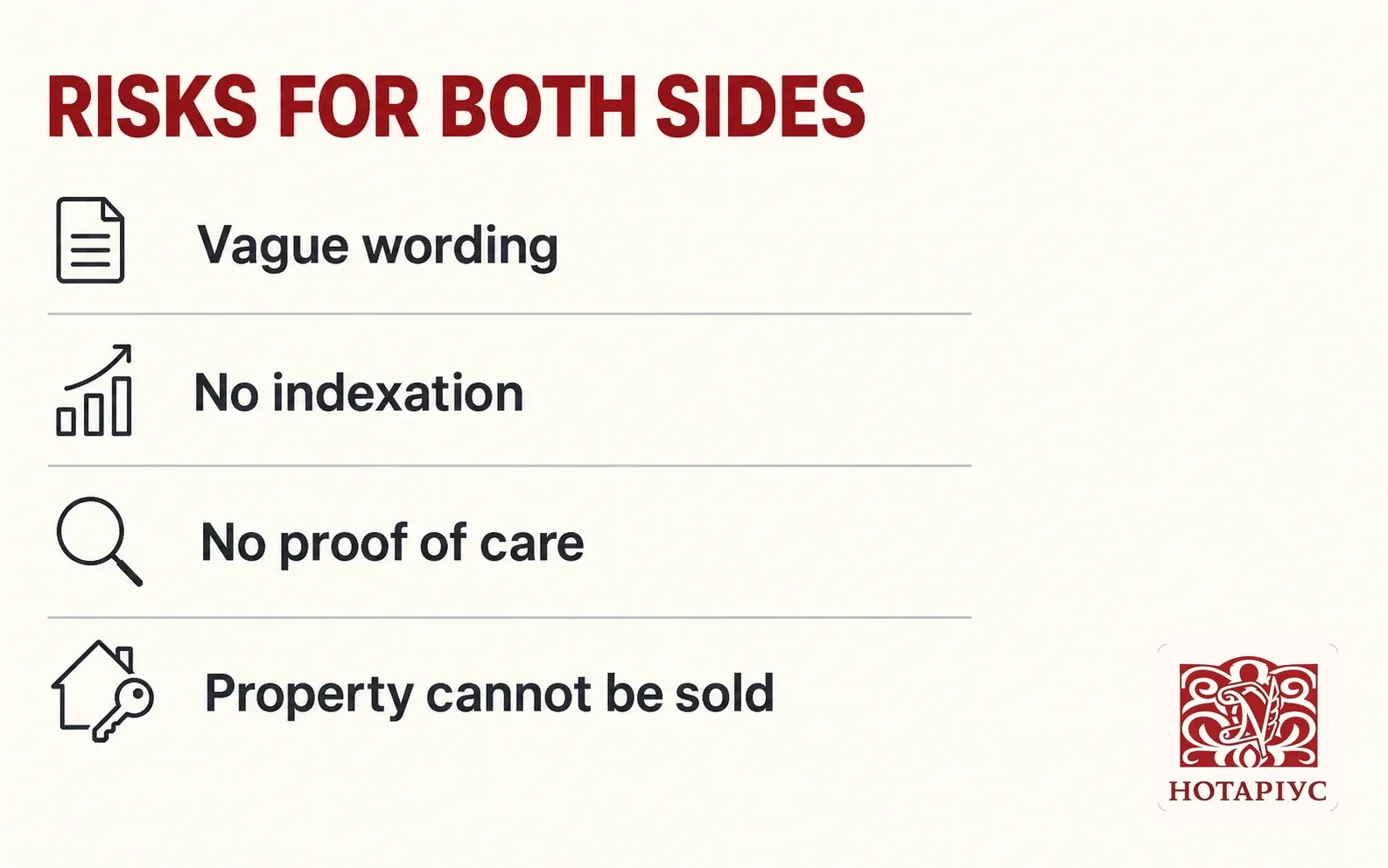
- Risk 1 — vague wording of duties. Protection: specific amounts, a list of care activities, and a monthly payment with a fixed due date.
- Risk 2 — non-performance years later. Protection: written evidence of every payment and every act of care; in case of non-performance, a claim to terminate the contract and recover the property (Article 755, part 1(1) of the Civil Code).
- Risk 3 — losing the home or worsening living conditions. Protection: a housing section naming the specific part of the premises under Article 750.
- Risk 4 — erosion of the monthly sum by inflation. Protection: a clause on indexation of the monetary value of the support under Article 751.
- Risk 5 — defective execution of the transaction. Protection: certification by a notary; homemade receipts about care create no legal consequences.
Risks for the acquirer
- The duties last for life and are not terminated by loss or damage to the property (Article 754, part 3).
- The property cannot be sold or pledged before the transferor dies — it will not serve as loan security.
- Costs incurred on maintenance and care are not recoverable if the contract is terminated for non-performance (Article 756, part 1).
- If the acquirer dies, the duties pass to the heirs who received ownership (Article 757) — refusing that part of the inheritance while keeping the property is not an option.
- Replacing the acquirer requires the transferor’s consent or a court decision (Article 752).
When the contract ends: death, termination, return of the property
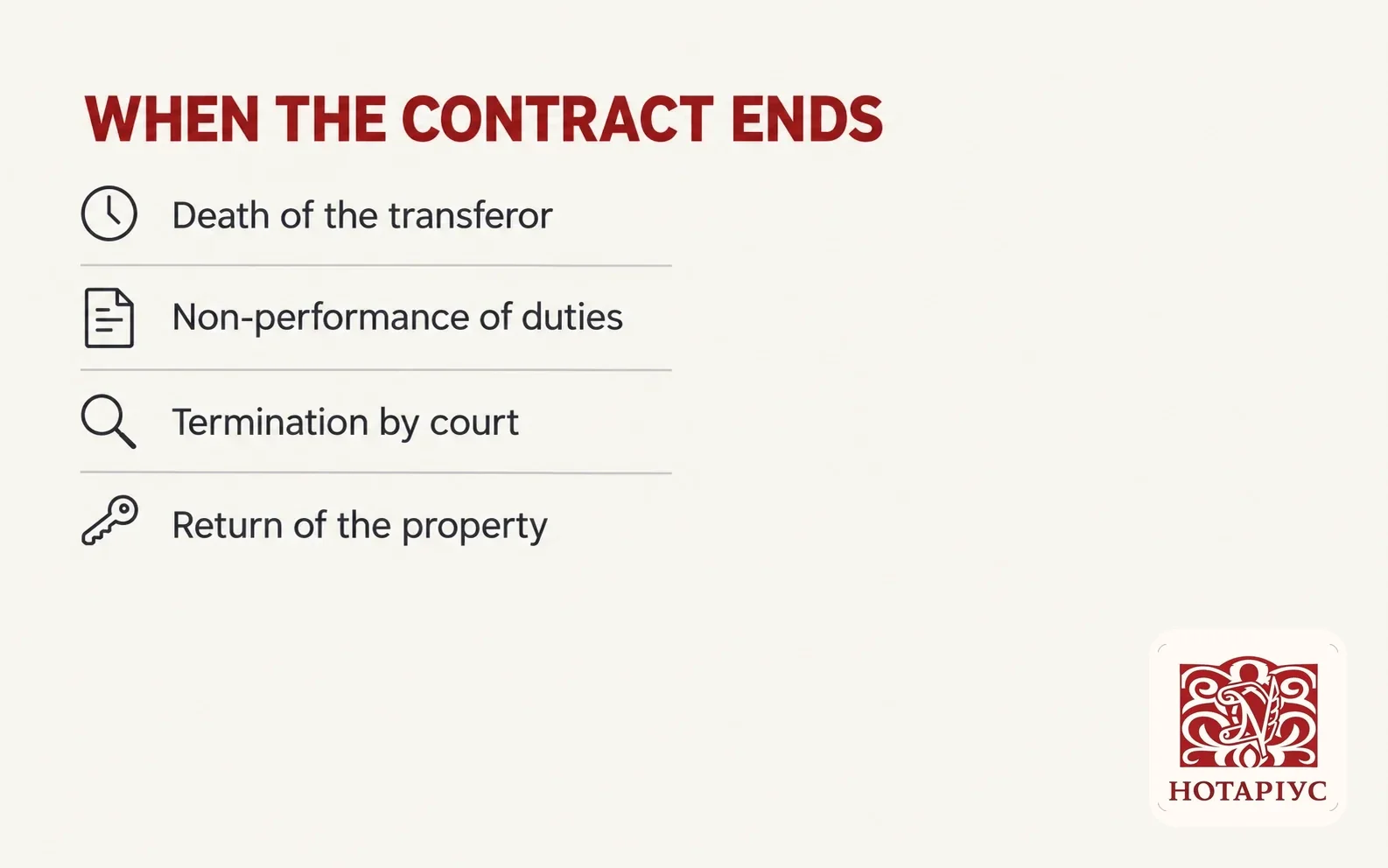
Article 755 of the Civil Code sets out two groups of grounds. The first is termination by a court decision: at the request of the transferor or of the third party in whose favour the contract was concluded, where the acquirer fails to perform or performs improperly — regardless of fault; and also at the request of the acquirer. The second is automatic termination on the death of the transferor.
A lifetime maintenance (care) contract may be terminated by a court decision: 1) at the request of the transferor or of the third party in whose favour it was concluded, in the event of non-performance or improper performance by the acquirer of their duties, regardless of fault; 2) at the request of the acquirer. A lifetime maintenance (care) contract terminates upon the death of the transferor.
Civil Code of Ukraine, Article 755
The legal consequences are set out in Article 756. Where the contract is terminated because of non-performance or improper performance of duties, the transferor recovers ownership of the property transferred and may demand its return. Costs incurred by the acquirer on maintenance and (or) care are not recoverable in that case.
How to terminate the contract: what the court decides
Termination does not happen by a unilateral statement. The procedure is:
- Collect evidence of improper performance: missing payments, an indexation calculation, witness statements that no care was provided, inspection records for the home.
- Send the acquirer a demand to perform the duties or return the property — a voluntary step often resolves the dispute without litigation.
- If the property is not returned, file a claim for termination of the contract and return of the property.
- In court, prove the scope of duties under the contract and the fact of non-performance; this is precisely why a contract with specific amounts and a list of care activities is decisive.
Supreme Court practice: a contract is terminated at the transferor’s request where the acquirer fails to perform or performs improperly, regardless of fault. In case No. 756/3891/21 the court found that the defendant had neither indexed nor paid the financial support in the amount provided by the contract, had not provided funds for utility bills and had not provided care. The Supreme Court held that non-payment of indexation and the absence of care may be grounds for termination, set aside the appellate ruling and remitted the case for a new hearing; that ruling contains no final conclusion that the contract was terminated.
The law also allows the acquirer to seek termination where further performance has become impossible for reasons of substantial importance. In that case the court may leave the acquirer with ownership of part of the property, taking into account how long the duties were properly performed (Article 756, part 2).
A further mechanism is replacement of the acquirer. If a natural person can no longer perform the duties for reasons of substantial importance, the duties may be transferred with the transferor’s consent to a family member of the acquirer or to another person. A refusal by the transferor to give consent may be challenged in court, which takes into account how long the contract has been performed and other relevant circumstances (Article 752).
What happens if the acquirer dies
Article 757 of the Civil Code deals with the death of the acquirer. The duties under the contract pass to the heirs who received ownership of the transferred property. If an heir under a will refuses to accept the property, ownership may pass to an heir at law. If there are no heirs, or they refuse the property, the transferor acquires ownership of it and the contract terminates.
For the transferor this means that the acquirer’s death does not leave them without a home or without grounds to claim support. For the acquirer’s heirs it means an obligation to continue the support, not merely a formal right to the apartment. Where the contract is connected with inheritance matters, the way an inheritance is arranged should be considered separately — see the guide to how inheritance is handled in Ukraine.
It is also worth remembering replacement of the asset: the parties may agree to replace the item transferred under the contract, and the acquirer’s obligations may be varied or left unchanged (Article 753). Such a replacement also requires notarial form and must not worsen the transferor’s position.
Conclusion
A lifetime maintenance contract is the most protective of the “family” arrangements for transferring property: the person receives lifelong support, while the transferred property cannot be sold, pledged or seized for the acquirer’s debts during their lifetime. That protection works only when the contract is drafted specifically — with an amount, a list of care activities, the part of the premises reserved for the transferor, and an indexation clause.
Before signing, calculate the fees on the basis of a valuation, check the title documents, and discuss the worst-case scenario with the notary: what happens if the duties are not performed. This material is for information only and does not replace a notary’s advice on a specific situation.
Frequently asked questions
What is a lifetime maintenance (care) contract?
Is notarial certification mandatory?
Who can be the acquirer?
Can the transferor keep living in the same apartment?
Can the acquirer sell the apartment before the transferor dies?
Can the acquirer’s creditors take the transferred property?
Can the contract be concluded in favour of a third party?
What happens with utility bills?
Must the monthly support be indexed?
Can the contract be concluded between relatives?
How much does certification cost?
Which documents are needed?
Is the other spouse’s consent required?
Can a share in an apartment be transferred?
Do the obligations decrease if one co-owner dies?
How can the acquirer be replaced?
Can the asset under the contract be replaced?
How is the contract terminated if the duties are not performed?
Are the acquirer’s costs reimbursed after termination?
Can the court leave part of the property to the acquirer?
What happens if the acquirer dies?
What happens if the transferred property is destroyed or damaged?
Who pays for the transferor’s funeral?
Does the transferor pay tax on the transfer?
Can the contract be cancelled unilaterally?
Kyiv notary: practical conclusions on the topic of the article
The material is based on applied practice. If your case differs from the standard one, a Kyiv notary will help you adapt the procedure to specific circumstances.
In most procedures, correct details, compliance with deadlines and the correct sequence of steps are decisive.