Inheritance by Will in Ukraine 2026: How to Make a Will, Accept an Inheritance and Not Miss the Deadline
Inheritance by will in Ukraine in 2026: how to make a will, who is entitled to a compulsory share, the 6-month deadline, debts and formalizing inheritance before a notary in Kyiv.

Inheritance by will allows a person to decide in advance who will receive their apartment, house, land plot, money, corporate rights and other property after their death. However, the mere existence of a will does not mean that the property automatically passes to the heir.
To formalize an inheritance, the procedure established by law must be followed, and in certain cases persons may be entitled to part of the estate even if the testator did not include them in the will.
As of August 28, 2026, the main rules of inheritance by will are governed by the Civil Code of Ukraine and the Procedure for Performing Notarial Acts by Notaries of Ukraine. In 2026, a new government Procedure for the functioning of the Inheritance Register within the e-notary System was also adopted.
What is a will
A will is a personal disposition of a natural person in the event of their death.
A natural person with full civil capacity has the right to make a will. A will is made personally: it cannot be drawn up through a representative under a power of attorney. The notarial procedure directly provides that a will is personally submitted to a notary and, as a general rule, personally signed by the testator.
This fundamentally distinguishes a will from many other transactions.
Who can be appointed as an heir in a will
The testator has fairly broad freedom in choosing heirs.
They may appoint one or several natural persons regardless of whether they are in family or kinship relations with them, as well as other participants in civil relations.
Therefore, an heir under a will does not necessarily have to be a husband, wife, child or other close relative.
The testator may also determine which particular property or which part of it a specific heir will receive.
Do you need to own the property at the time of making the will
This is an important nuance that is often misunderstood.
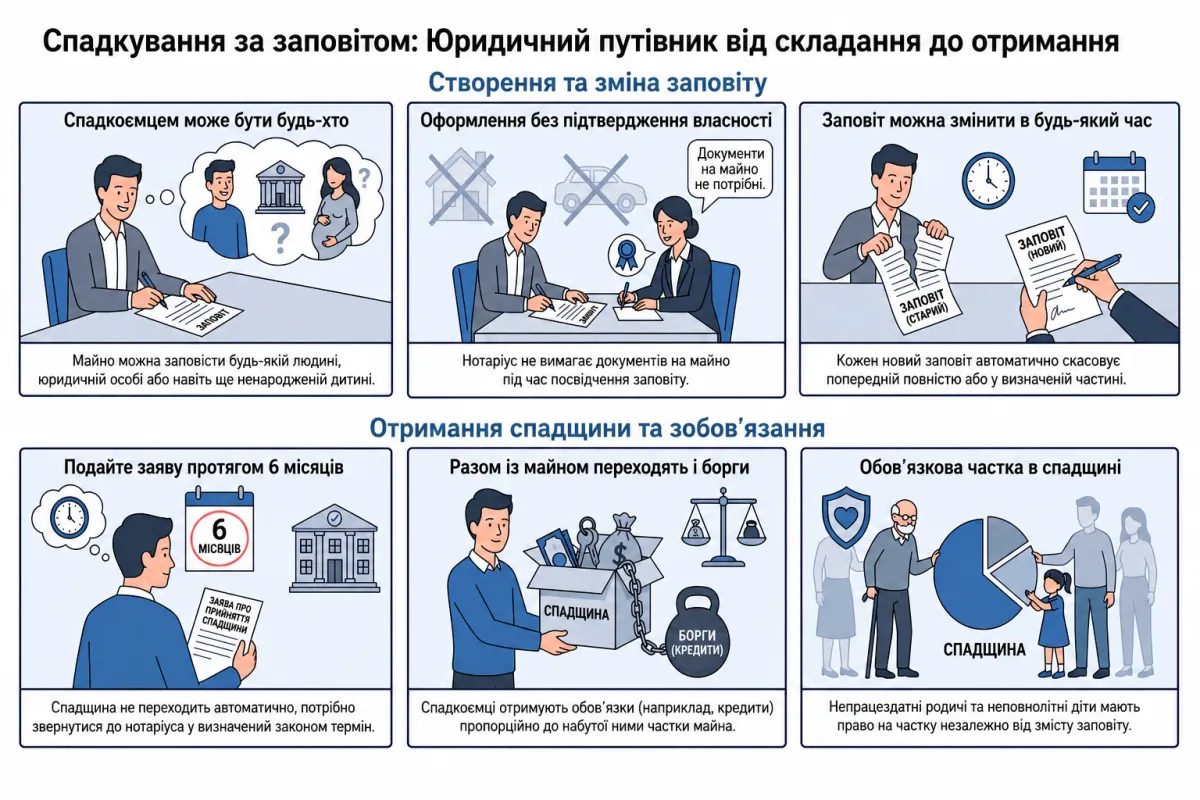
When certifying a will, the notary does not require the testator to provide documents confirming ownership of the bequeathed property. This is directly provided for by the current Procedure for Performing Notarial Acts.
Therefore, when making a will, the procedure differs, for example, from selling or gifting an apartment.
However, this does not mean that someone else's property can be transferred by will after death. When formalizing the inheritance, the notary already establishes the composition of the estate and checks the necessary documents.
What requirements apply to a will
A will must comply with the requirements of legislation regarding form and content.
It must indicate the place and time of drafting, as well as the information about the testator provided for by law. A will must be drawn up so that the testator's will does not cause uncertainty or disputes after the opening of the inheritance.
The notary checks whether the document contains dispositions that contradict the legislation.
Can a will be changed
Yes. The testator is not bound by their decision forever.
They have the right at any time:
• to revoke the will;
• to make a new will;
• to make changes in accordance with the established procedure.
In this case, a new will revokes the previous one in full or in the part in which its provisions contradict the new will. The testator's right to change and revoke their last will is provided for by Article 1254 of the Civil Code of Ukraine.
Is a will registered
Yes.
Information about a will, its amendment and revocation is subject to state registration in the Inheritance Register.
In 2026, the Cabinet of Ministers of Ukraine approved a new Procedure for the functioning of the Inheritance Register as a component of the e-notary System. The register provides for the processing of information, in particular, about wills, inheritance contracts, certificates of the right to inheritance, opened inheritance cases, amendments and revocations of wills.
Therefore, when formalizing an inheritance, the notary can establish the existence of a registered will in the manner prescribed by law.
Who can certify a will
In an ordinary situation, a will is certified by a notary.
At the same time, the law provides for cases where wills may be certified by officials or service persons defined by law. Such wills, subject to the established requirements, are equated to notarized wills.
This may be relevant, for example, when a person is in a medical institution or in other special circumstances defined by law.
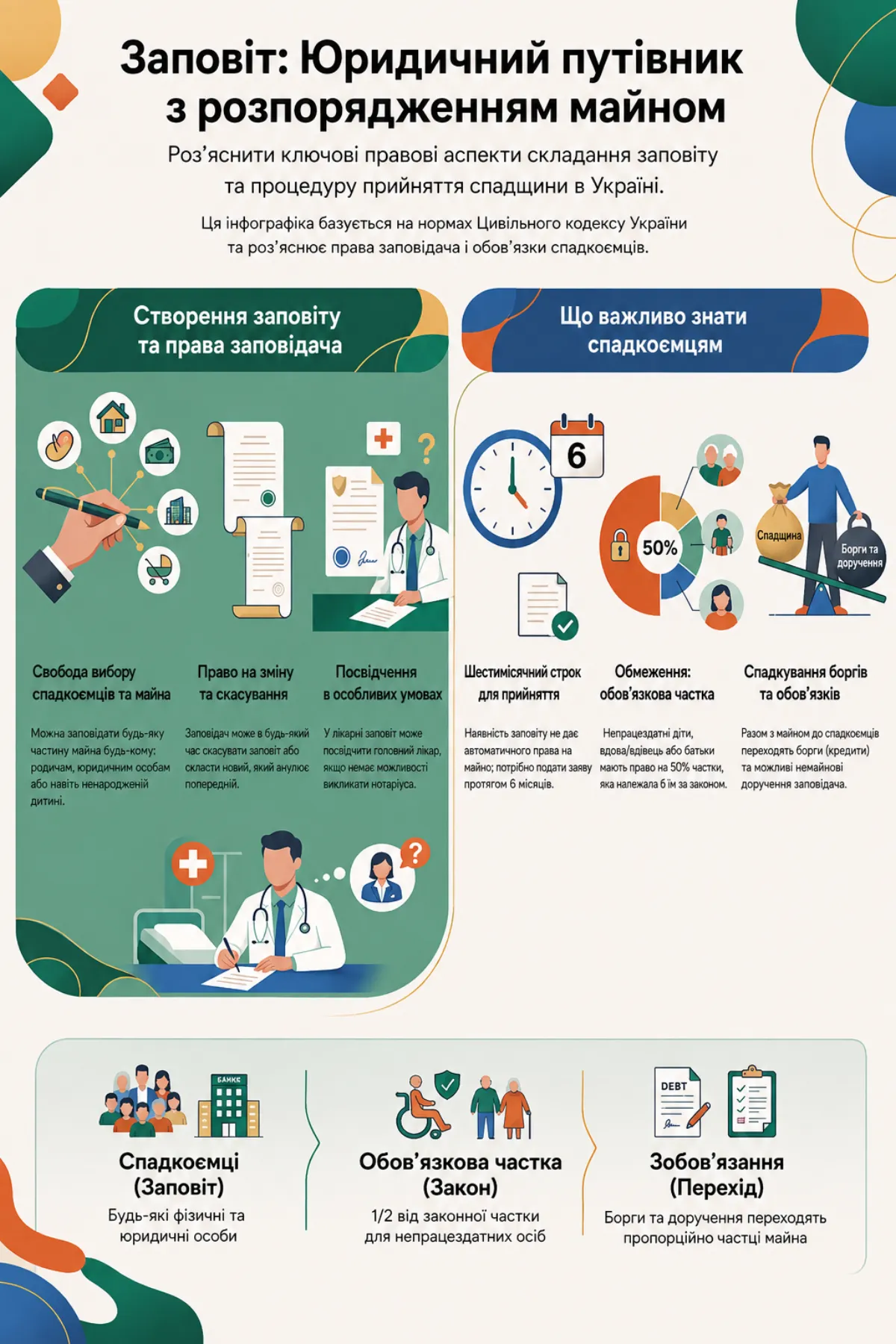
Therefore, the thesis from the infographic that 'in a hospital a will can be certified by the chief physician' should not be treated as a universal rule for any doctor or any situation.
What happens after the testator's death
After a person's death, the inheritance is opened.
The existence of a will determines the testator's will regarding the distribution of property, but the heir must go through the procedure of formalizing inheritance rights.
The notary, in particular, checks:
• the fact of the testator's death;
• the time and place of opening the inheritance;
• the existence of a will;
• the composition of the estate;
• persons entitled to a compulsory share;
• other legally significant circumstances.
How much time is given to accept an inheritance in 2026
The general period for accepting an inheritance or refusing it is six months.
The countdown starts from the time of opening the inheritance, and in cases specially provided for by law — from the day of state registration of death.
The current notarial Procedure directly establishes a six-month period.
This is one of the most important deadlines in inheritance cases.
At the same time, the phrase 'every heir must necessarily file an application within six months' should not be used without reservations: the law provides for specific features of accepting an inheritance for certain categories of heirs and situations.
Therefore, the course of action is best determined with regard to the specific inheritance case.
What happens if you miss the 6 months
The consequences can be significant.
If a person who was supposed to declare acceptance of the inheritance did not do so within the established period, they may be considered to have not accepted the inheritance.
At the same time, the law provides for mechanisms to resolve the issue of a missed deadline. In particular, a court may grant the heir an additional period sufficient to file the application if the deadline was missed for a valid reason.
Therefore, after missing the six-month deadline, one should not automatically consider the inheritance finally lost — the specific circumstances must be assessed.
When is a certificate of the right to inheritance issued
As a general rule, a certificate of the right to inheritance is issued to heirs who have accepted the inheritance after the end of the six-month period.
At the same time, after proper acceptance of the inheritance, the issuance of the certificate itself is not limited by a general final deadline.
This is another reason not to confuse two different concepts: the period for accepting the inheritance and the period for obtaining a certificate of the right to inheritance.
Compulsory share in the inheritance: who can receive property despite the will
Freedom of testament in Ukraine is not absolute.
Article 1241 of the Civil Code protects a defined circle of persons. Regardless of the content of the will, the right to a compulsory share may be held by:
• the testator's minor children (under 14);
• the testator's children aged 14 to 18;
• the testator's adult children who are unable to work;
• a widow or widower who is unable to work;
• the testator's parents who are unable to work.
As a general rule, they inherit half of the share that would have belonged to each of them in inheritance by law.
Therefore, the '50%' designation on the infographic does not mean that such a person automatically receives half of all property.
For example, if their legal share would have been 1/4 of the estate, the compulsory share as a general rule will be half of that 1/4, not 50% of the entire estate.
Can the testator deprive such a person of inheritance
By the will itself — no.
The notarial Procedure directly provides that the testator cannot deprive a person who has the right to a compulsory share of the right to inherit.
The circle of such persons is determined on the day of opening the inheritance, not on the day of making the will.
That is why, when making a will, the notary explains to the testator the provisions of Article 1241 of the Civil Code of Ukraine.
Do debts pass together with the inheritance
Accepting an inheritance may mean receiving not only assets.
The estate may include the rights and obligations of the testator that have not ceased as a result of their death.
Therefore, before accepting an inheritance, it is advisable to assess not only the apartment, land, car, bank funds or other property, but also possible debt obligations of the testator.
At the same time, the statement 'the heir inherits all debts without limits' would be incorrect. The law establishes special rules regarding creditors' claims and the limits of heirs' liability.
Can you accept an apartment but refuse the debts
As a general rule — no.
Acceptance of an inheritance does not happen on the principle of 'I take what is profitable and leave what is not'.
The current Procedure directly states that acceptance of an inheritance or refusal of it concerns the entire estate: an heir cannot accept one part of the inheritance and refuse another.
That is why, before formalizing a significant inheritance, it is worth clarifying its full composition.
Will or inheritance by law: what is the difference
If there is a valid will, the testator's will is taken into account first, subject to the exceptions provided for by law, in particular the right to a compulsory share.
If there is no will, it is invalid or does not cover a certain part of the estate, the rules of inheritance by law apply in the relevant part.
Therefore, a properly drafted will allows the future fate of the property to be determined much more precisely.
What documents are needed to formalize an inheritance by will
There is no single universal list for every inheritance case — it depends on the composition of the estate and the specific circumstances.
Typically, the notary may need documents and information necessary for:
• establishing the heir's identity;
• confirming the testator's death;
• determining the time and place of opening the inheritance;
• establishing the composition of the estate;
• confirming the testator's right to the relevant property;
• establishing other circumstances of the specific inheritance case.
The existence of a will does not cancel the need to verify rights to an apartment, house, land or other property when issuing a certificate of the right to inheritance.
Inheriting an apartment by will
If the estate includes an apartment, the notary must establish that the relevant property belongs to the testator and other necessary legal circumstances.
After formalizing the inheritance rights, the heir's ownership right to real estate is subject to state registration in the manner prescribed by law.
Apartments and houses whose rights arose many years ago and whose data are absent or incompletely reflected in modern electronic registries may require special attention.
The most common mistakes in inheritance by will
Most often, problems arise not because of the mere existence of a will, but because of a misunderstanding of the procedure.
For example, an heir may believe that the will automatically makes them the owner of the apartment, miss the deadline for the necessary actions, fail to take into account another person's right to a compulsory share, or fail to check for debt obligations.
The testator, for their part, may draw up a document with unclear wording or fail to take into account the legal consequences of distributing specific property.
That is why the content of the will and the subsequent formalization of the inheritance must comply with the requirements of the law, and not only with the everyday understanding of the testator's will.
Inheritance by will in 2026: what to remember
A will allows a person to determine the fate of their property after death, but freedom of testament has limits established by law.
The testator may choose heirs, change or revoke the will. When certifying it, the notary does not require proof of ownership of the bequeathed property. Information about the will and its changes is registered in the Inheritance Register.
After the inheritance is opened, it is important to determine the necessary procedure for accepting it in a timely manner. The general period is six months, and when formalizing the inheritance, the notary also checks persons who may be entitled to a compulsory share.
If you need to make a will in Kyiv, change or revoke a will, formalize an inheritance by will or get advice on an inheritance case, contact our notary office. Also check out these sections: certificate of the right to inheritance by will, opening an inheritance case and application for acceptance of inheritance.
Kyiv notary: practical conclusions on the topic of the article
The material is based on applied practice. If your case differs from the standard one, a Kyiv notary will help you adapt the procedure to specific circumstances.
In most procedures, correct details, compliance with deadlines and the correct sequence of steps are decisive.